 Cosmic Insights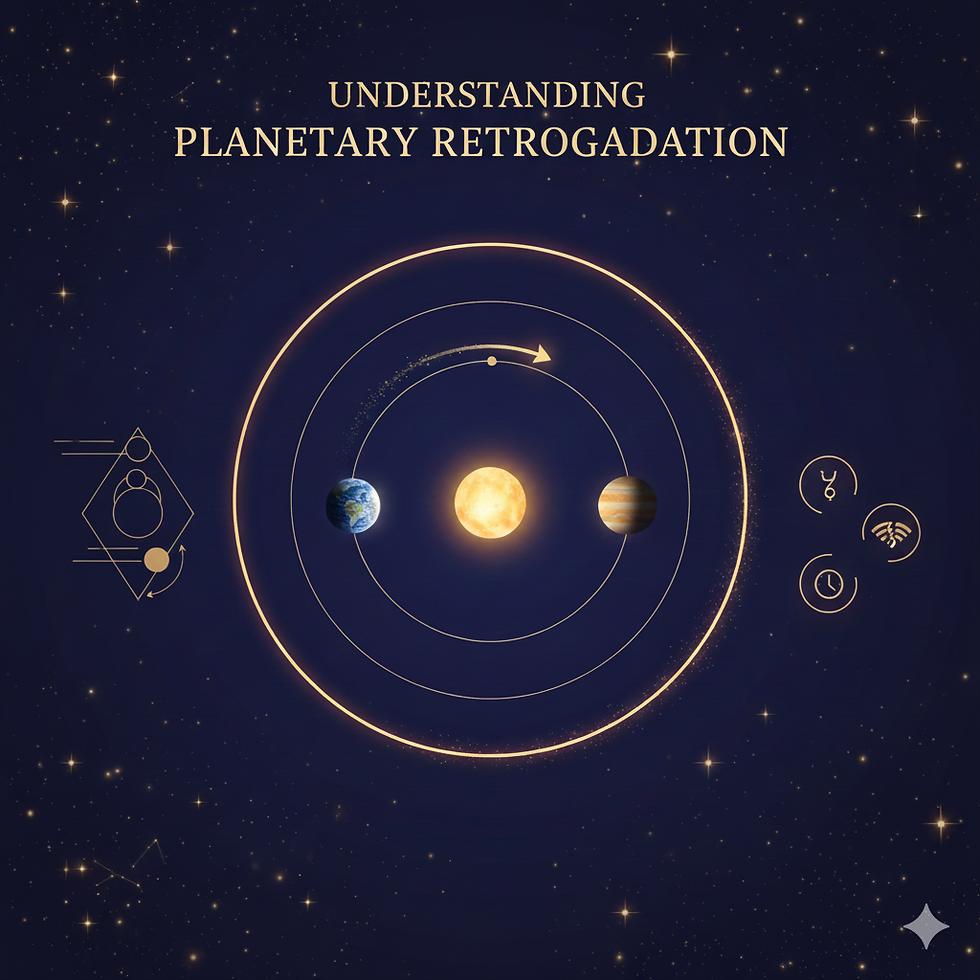
Retrograde Planets in Astrology: Meaning and Traditional Significance
Retrograde motion is an interesting astronomical phenomenon in which a planet appears to move backward against the background stars when observed from Earth. The planet does not actually reverse its orbit around the Sun.
This apparent backward motion occurs because Earth and other planets travel around the Sun at different speeds and along different orbital paths. When their relative positions change in a particular way, a planet can appear to slow down, stop and move backward for a period of time.
In astrology, retrograde motion has traditionally been given additional significance. Astrologers may interpret retrograde planets through themes such as reflection, reassessment, repetition and internal development.
What Does Retrograde Mean?
From Earth, planets generally appear to move across the zodiac in one direction. During retrograde motion, however, the planet appears to move in the opposite direction for a certain period.
This is an apparent motion, not an actual reversal of the planet's orbit. The planet continues moving around the Sun according to its normal orbital path.
Retrograde motion is therefore an astronomical observation, while the meanings associated with it in astrology belong to the traditional interpretive system.
Retrograde Planets in Vedic Astrology
In traditional Vedic astrology, retrograde planets may be given special consideration when interpreting a birth chart. A retrograde planet may symbolically indicate that the themes represented by that planet are experienced in a more reflective or internal manner.
However, a retrograde planet is not automatically considered negative. Its traditional interpretation depends on the planet, zodiac sign, house, aspects, conjunctions and the rest of the birth chart.
Mercury Retrograde
Mercury is traditionally associated with communication, learning, reasoning, writing, information and commerce.
Mercury retrograde is particularly well known in modern astrology. Traditional interpretations may encourage people to review communication, plans, documents and decisions during such periods.
In a birth chart, a retrograde Mercury may traditionally be interpreted through a person's individual style of thinking, learning and communication.
Venus Retrograde
Venus is traditionally associated with relationships, beauty, creativity, attraction, comfort and personal values.
Venus retrograde is traditionally interpreted through themes of reviewing relationships, values, preferences and creative interests. It can also be viewed symbolically as a period of reflection about what a person genuinely values.
Mars Retrograde
Mars represents energy, courage, action, initiative and determination in traditional Vedic astrology.
A retrograde Mars may traditionally be interpreted as a period for reconsidering actions, motivations and the way energy is directed toward goals.
Jupiter Retrograde
Jupiter is traditionally associated with knowledge, wisdom, learning, growth, guidance and expansion.
Jupiter retrograde may traditionally be associated with reflection on beliefs, education, knowledge and personal development. It can encourage deeper consideration of previously learned ideas and principles.
Saturn Retrograde
Saturn is traditionally associated with discipline, responsibility, patience, structure and long-term effort.
Saturn retrograde is traditionally interpreted through themes involving responsibilities, commitments and long-term lessons. Astrologers may use this period to reflect on whether existing structures and responsibilities remain appropriate.
Is Retrograde Always Negative?
No. Retrograde motion is not automatically considered negative in traditional astrology. The interpretation depends on the individual planet and its position in the complete birth chart.
A retrograde planet may traditionally be viewed as creating opportunities for reflection, reassessment and deeper understanding rather than simply being treated as an unfavorable influence.
Frequently Asked Questions
What is a retrograde planet?
A retrograde planet is a planet that appears to move backward against the background stars when observed from Earth.
Does a planet actually move backward?
No. The planet continues following its normal orbit around the Sun. Retrograde motion is an apparent effect caused by the relative movement of Earth and the other planet.
Is Mercury the only retrograde planet?
No. Several planets can appear retrograde from Earth's perspective at different times. Mercury simply receives particularly strong attention in popular astrology.
Is retrograde always bad?
No. Traditional interpretations vary depending on the planet, its placement and the complete birth chart.
Conclusion
Retrograde motion is a fascinating astronomical phenomenon caused by the relative movement of planets and Earth. While the planet does not actually reverse its orbit, its apparent movement has developed an important symbolic meaning in astrology.
In traditional Vedic astrology, retrograde planets are studied alongside the complete birth chart rather than being automatically classified as good or bad. Understanding both the astronomical phenomenon and its traditional interpretation gives readers a clearer view of the concept.
Disclaimer: Astrological interpretations of retrograde planets are traditional beliefs and are not scientifically proven methods of predicting future events, behaviour or outcomes.